
08 April 2026
ANZAC sports during World War I
Whether on the open sea, the shifting sands of the Middle East, the cricket and rugby fields of England, or the muddy grounds of the Western Front, the Aussies were always ready for a match.
Passing time on the journey to and from war
The journey to and from war took approximately four weeks each way. Shipboard sport played an important role in maintaining fitness, building team cohesion and relieving the tedium of a long sea voyage. Despite the cramped conditions, sailors and soldiers managed to find space for impromptu games of football and cricket.
In the absence of sporting equipment, they made do with objects converted from what was available. Decks became temporary boxing rings or athletic tracks, while less formal games – such as three-legged, wheelbarrow and egg-and-spoon races – proved equally popular.
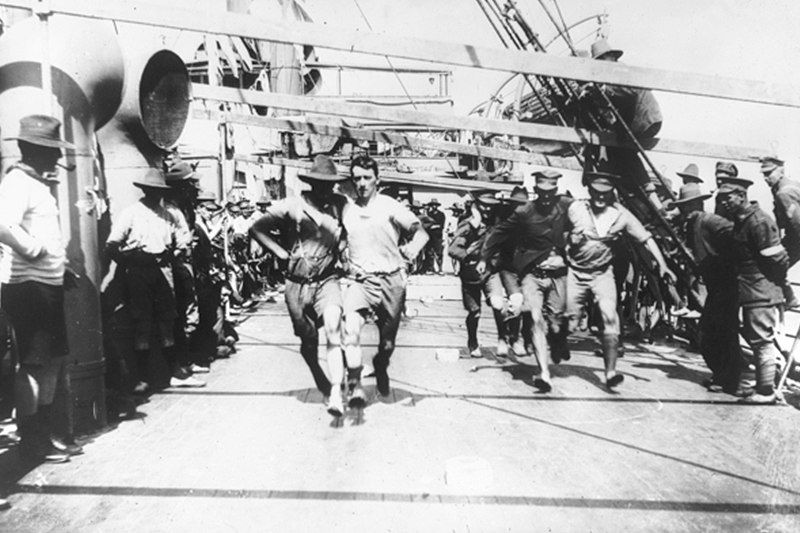
Members of the Australian Imperial Force (AIF) participate in a three-legged race aboard the SS Port Nicholson in 1916. Photo: Australian War Memorial CO1573
Cricket under fire: Shell Green, Gallipoli
Arguably the most famous cricket match played by the Anzacs during WWI took place at Shell Green, Gallipoli, on 17 December 1915. Shell Green was located south of Ari Burnu and overlooked the Aegean Sea.
While it had obtained its name from the enemy’s propensity to shell the site, it nevertheless contained a relatively flat and barren patch of ground well suited to the needs of a cricket team. With plans for the Australian evacuation underway and shells flying overhead, the players successfully distracted the Turks while also surviving the match.
Charles Bean – who would go on to become Australia’s Official War Historian – watched the precipitous match and captured the moment that Major George Macarthur Onslow was caught out (pictured below).
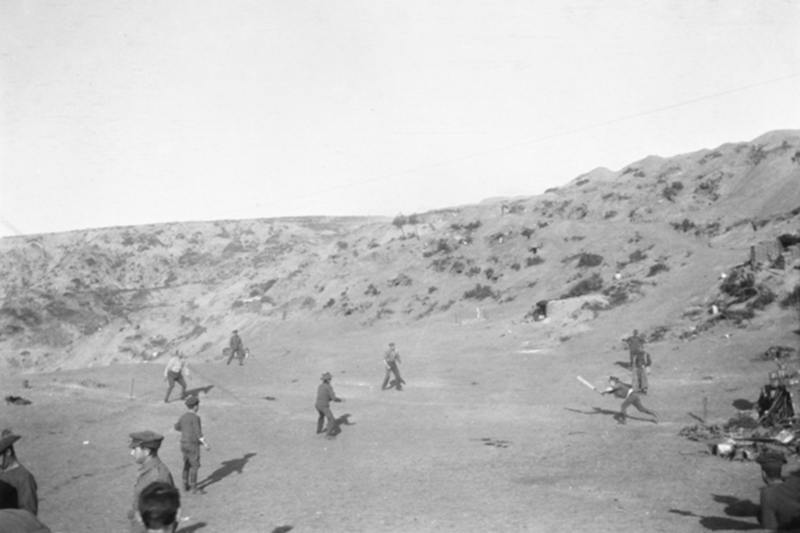
Charles Bean’s photograph of the December 1915 cricket match at Shell Green, Gallipoli. Photo: Australian War Memorial G01289
Nurses at play
Nurses were not excluded from the benefits of sport while serving abroad with the AIF. Although encumbered by their long skirts and aprons, they frequently played cricket against their patients. In India, the nurses’ team looked the part in their lightweight dresses, which conveniently also served as cricket whites!
In mid-1915, nurses of the No.1 Australian Auxiliary Hospital at Harefield Park, England, took to the field to play their patients. Many of these men were convalescing from physical and emotional injuries sustained at Gallipoli, and some were missing limbs. Despite these limitations, the patients nevertheless won the match.
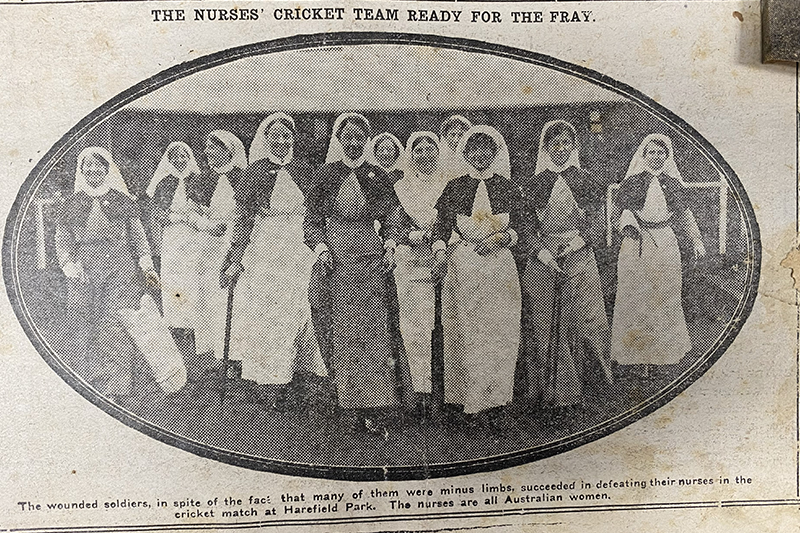
The Nurses’ Eleven take to the field at Harefield Park in mid-1915. Photo: Mirror of Australia, 4 December 1915, 10.
Sport at the heart of the first ANZAC Day
On 25 April 1916, Australian troops at Ferry Post in Egypt were given the day off to commemorate the landing at Gallipoli 12 months earlier. The day unfolded in a way that would have felt familiar to Australians at home and abroad.
In the morning, camp chaplains delivered a commemorative service. After hymns and an address by the commanding officer, the men marched back to their parade ground and fell out. The rest of the day was dedicated to a sports carnival: horseback wrestling, swimming in the nearby Suez Canal and other aquatic events, before a concert brought the day to a close.
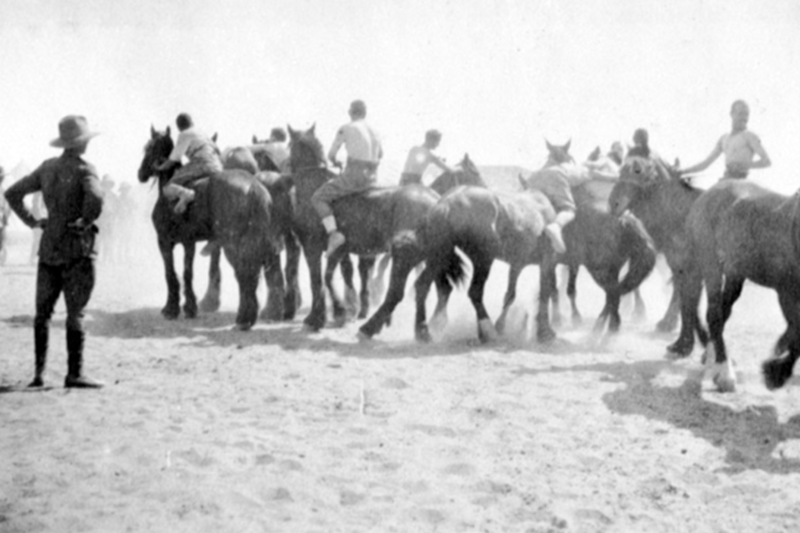
Horseback wrestling during an ANZAC Day sports carnival held at Ferry Post in Egypt on 25 April 1916. Photo: Australian War Memorial C04996
Taking the team to war
During WWI, sporting teams often enlisted together to serve at the front. Teams proudly announced tallies of colleagues who had gone to “join the colours” in their local newspapers and many claimed to hold the record for club recruitment.
By mid-1916, no fewer than 38 members of the Warrnambool Cricket club had enlisted; East Sydney had farewelled at least 50 members of its local athletics club; and 66 members of the Glebe Rugby Club had “shown their fighting spirit.”
In some cases, the drain on membership affected the club’s viability. In Melbourne, Fairfield Hockey Club disbanded due to a paucity of players while in some cases junior members – “men of non-military age” – were relied upon to keep senior teams competitive.
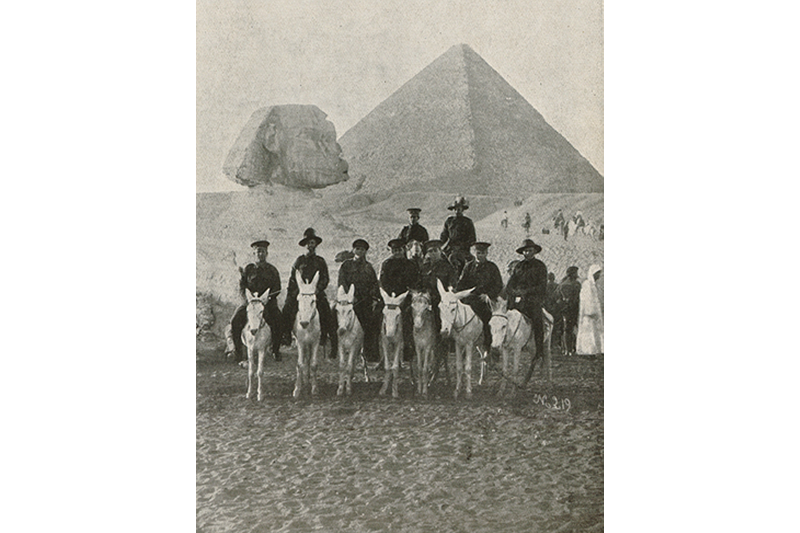
Nine of the 31 members of the Alderley Cricket Club who enlisted to serve abroad during WWI. Photo: Queenslander, 3 June 1916, 27
“Good cricketers and charming men”: the Australian Services Cricket Team
After the Armistice, the challenge of returning thousands of men to Australia emerged. Cricket offered one way to keep them occupied while they waited to embark.
Australia’s team of soldier cricketers opened their tour of Britain in mid-May 1919. Over the next four months they played 28 first-class matches against primarily county sides.
The Aussies won 12 games, drew 12, and suffered only four losses. Back home, Australians were thrilled at the team’s success, which was reported in the pages of their local press. Apart from being a sensation, the tour also launched the careers of several test cricketers, including all-rounder Herbie Collins and wicket-keeper Bert Oldfield.
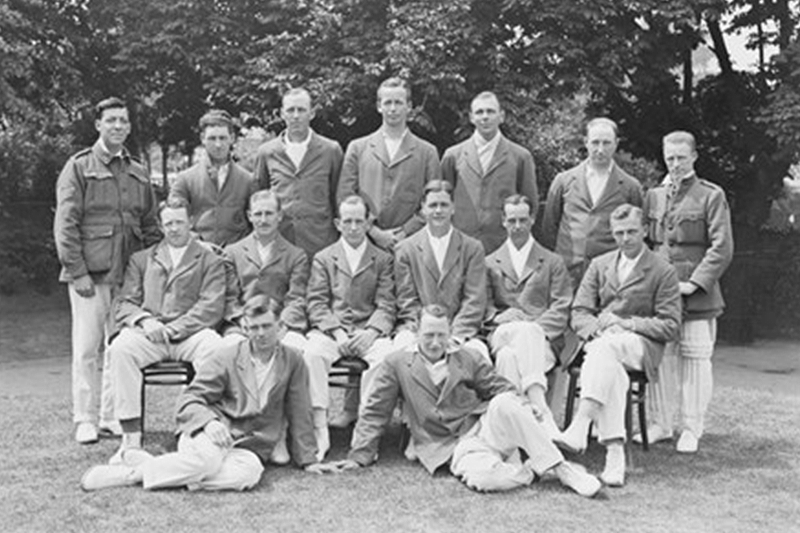
The popular Australian Services Cricket Team at Lords Cricket Ground in September 1919. Bert Oldfield is standing at the far right in the back row and Herbie Collins is seated third from the left in the middle row. Photo: Australian War Memorial D00685
The legacy continues…
Sport remains an important part of our ANZAC tradition. But did you know that until 1958 – 1964 in Queensland – organised sport was banned on ANZAC Day? The WWI veterans jealously guarded 25 April as an official day of mourning for their fallen mates, and by the 1930s restrictions on a range of businesses and activities maintained the solemnity of the day: hotels and theatres remained shut and organised sport was prohibited.
After WWII, younger veterans began railing against the “deadly air of dullness” that prevailed on the afternoon of 25 April each year. With growing community support, legislation was changed to accommodate organised sport… but only with ministerial approval and only after 1pm!
Let’s show the ANZAC spirit lives here.
ANZAC Day is more than simply a date on the calendar.
It’s a time for Australians and New Zealanders to come together and honour the courage, sacrifice and mateship of all who have served.
It’s a call to carry those values forward every day, and a reminder of just how lucky and grateful we are.
So, whether you join a Dawn Service, pause at home in quiet reflection, or share stories with family and friends, your participation matters. Every action, big or small, honours the ANZACs and shows us that the ANZAC spirit lives here.